What Principled Means
Objective
Define what DSAMbayes means by a principled Bayesian MMM workflow.
The term is intentionally about process, not brand loyalty to a particular model class or sampler. A principled workflow is one where assumptions are explicit, diagnostics are stage-gated, and downstream interpretation is conditioned on those gates.
The short definition
A DSAMbayes workflow is principled when it does all of the following:
- states a clear modelling objective and decision context
- specifies an explicit model with explicit priors and boundaries
- checks whether the posterior computation is trustworthy
- checks whether the fitted model is adequate for the data
- carries uncertainty and gate status into decomposition, optimisation, and reporting
If any one of those steps is skipped, the workflow becomes less defensible even if the final coefficients look plausible.
Workflow contract at a glance
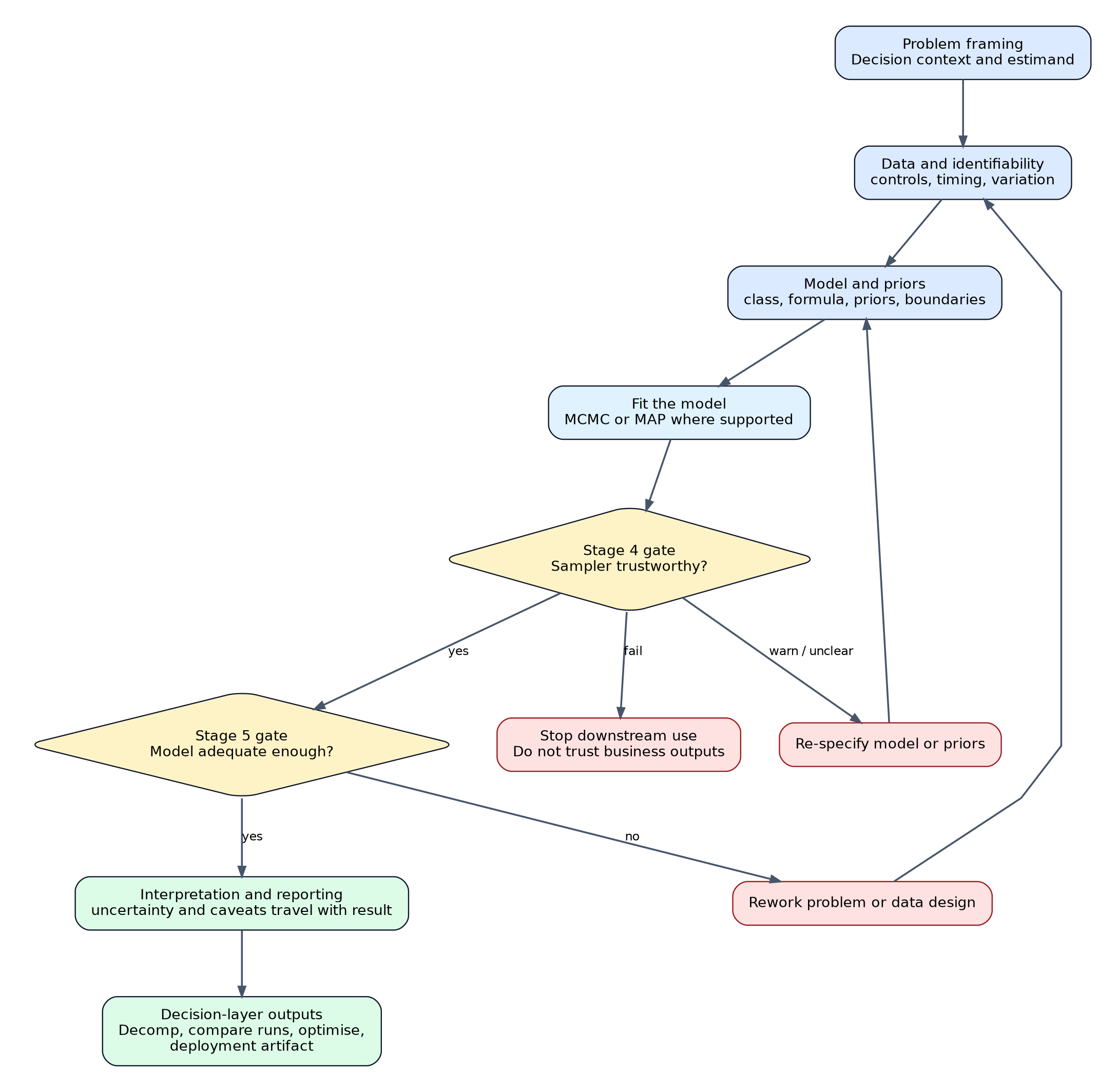
The key design choice in DSAMbayes is that downstream outputs are conditional on upstream gates. A model that fits is not automatically a model that should be decomposed, compared, optimised, or deployed.
Four commitments
1. Generative transparency
The model should tell a clear story about how the outcome is generated from:
- media terms
- baseline structure
- controls
- observation noise
That is why DSAMbayes exposes priors, boundaries, response scale, CRE terms, time components, and model classes explicitly. The point is not to burden users with knobs; it is to make assumptions inspectable.
2. Stage-gated inference
The workflow should move in order:
- question and data design
- model and priors
- fit
- computational diagnostics
- model adequacy checks
- interpretation and decision support
Downstream outputs should only be trusted if the upstream gates have been checked.
3. Diagnostic sufficiency for computation, not causality
Diagnostics answer questions like:
- did the sampler converge?
- are the posterior draws stable?
- does the fitted model describe the observed data credibly?
Diagnostics do not answer:
- did the model identify the true causal effect of media?
- did we control for every relevant confounder?
- is the chosen baseline structure the only defensible one?
This distinction is essential in MMM.
4. Decision-linked reporting
Decomposition shares, response curves, deployment artifacts, and budget recommendations should be treated as functions of the gated fit, not as standalone truths. If the fit has warnings or failures, those limitations must travel with the result.
The three layers of trust
DSAMbayes users should separate three different questions:
| Layer | Question | Typical evidence |
|---|---|---|
| Computational faithfulness | Are the draws numerically trustworthy? | Rhat, ESS, divergences, treedepth, BFMI |
| Model adequacy | Does the model describe the observed data credibly? | fitted-vs-observed, PPC, residual behaviour, LOO/Pareto-k |
| Causal credibility | Are the media effect estimates interpretable as causal? | analyst judgment, design quality, confounder handling, identification logic |
Passing the first layer does not imply the second. Passing the second does not imply the third.
How DSAMbayes supports this workflow
DSAMbayes already provides several pieces of the workflow contract:
- explicit model classes and response-scale semantics
- default priors plus selective overrides and hard boundaries
- pre-flight design checks
- post-fit diagnostics with pass / warn / fail statuses
- staged runner artifacts under
results/ - model comparison and optional time-series selection tooling
- decision-layer optimisation with uncertainty-aware summaries
What the package cannot do automatically is replace analyst judgment about:
- business estimands
- causal assumptions
- whether a structural prior is genuinely defensible
- whether a warned run is acceptable for the specific business use
Failure policy in plain language
If Stage 4 fails
Do not trust decomposition, response curves, or optimisation outputs. The posterior sample itself is numerically unreliable.
If Stage 5 fails
The sampler may have worked, but the model is not yet adequate for business interpretation. Use the run for diagnosis, not for stakeholder recommendations.
If causal assumptions are weak
Even a clean computational and adequacy profile may still only support associational interpretation. Report it that way.